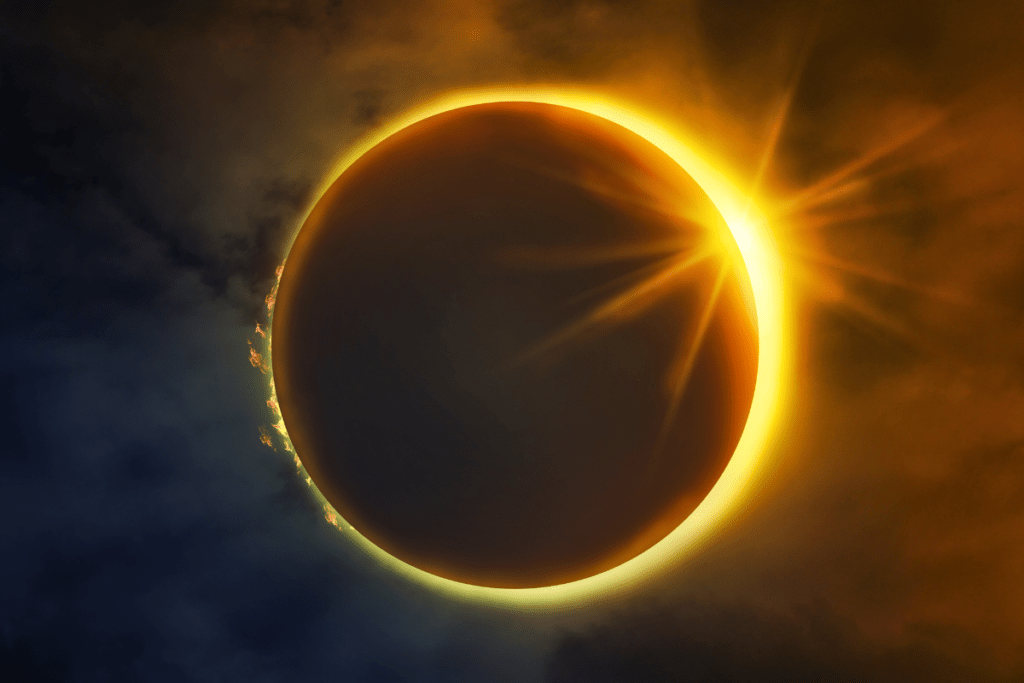
As you know, on April 8, 2024, a rare and stunning celestial event will unfold—a total solar eclipse visible across North America, from Mexico to Newfoundland, Canada. However, this astronomical solar eclipse event holds more than just visual beauty; it presents a golden opportunity for scientific discovery. NASA’s extensive 2024 solar eclipse studies are shedding light on the Sun’s influence on Earth’s atmosphere, ionosphere, and corona structure. These groundbreaking studies, which involve both professional researchers and citizen scientists, are expanding our understanding of Sun-Earth interactions in unprecedented ways.
The Total Solar Eclipse: A Brief Overview
A total solar eclipse occurs when the Moon passes directly between Earth and the Sun, casting its shadow across a portion of the Earth’s surface. During totality, the Sun’s light is completely blocked out, revealing phenomena like the Sun’s corona, a plasma-filled outer atmosphere that is usually obscured by the Sun’s bright light. The 2024 eclipse, which will be visible across North America, offers scientists a unique opportunity to study the Sun’s corona and observe how its sudden disappearance impacts Earth’s atmospheric and ionospheric conditions.
Citizen Scientists and Researchers Join Forces
NASA’s 2024 eclipse studies are not just limited to professional researchers; citizen scientists have played a crucial role in collecting data and contributing to our understanding of the event. Thousands of volunteer observers stationed along the eclipse’s path gathered essential data, helping to deepen our knowledge of solar interactions with Earth’s atmosphere. This collaboration between professionals and the public exemplifies the power of community science in advancing research.
Citizen CATE 2024: Capturing the Corona’s Mysteries
One of the standout projects during the 2024 eclipse is the Citizen CATE 2024 (Continental-America Telescopic Eclipse) project. This initiative involved 35 observation teams across the United States, from Texas to Maine, capturing over 47,000 images of the Sun’s corona during totality. The goal was to observe how the corona changes during the brief moment when the Sun is fully obscured by the Moon.
Sarah Kovac, the project manager at the Southwest Research Institute, presented the first set of images and an early movie derived from the observations. These images, captured in polarized light, provide new insights into the structure and dynamics of the Sun’s corona, which is essential for understanding solar wind, space weather, and the Sun’s long-term behavior.
High-Flying Observations with NASA’s WB-57 Aircraft
At the same time, NASA’s WB-57 aircraft, equipped with imaging cameras and spectrometers, flew above the eclipse’s path to extend the observation time beyond the few minutes available on the ground. By flying within the Moon’s shadow, the aircraft was able to observe the eclipse for a total of 6 minutes and 20 seconds. These observations, led by Shadia Habbal of the University of Hawaii, provided critical data on the Sun’s corona, although some images were affected by vibrations in the aircraft. Despite these challenges, the data gathered was invaluable, and scientists are already planning to use similar platforms for future eclipses.
Solar Eclipse’s Impact on Earth’s Atmosphere
While the Sun’s corona is a focal point of NASA’s 2024 eclipse studies, the event has also provided fascinating insights into the Earth’s atmosphere, particularly how it reacts to the sudden loss of sunlight during totality. Several amateur radio and ballooning projects have contributed to this research, revealing disruptions and phenomena triggered by the eclipse.
The HamSCI Project: Unveiling the Ionospheric Effects
Amateur radio operators, often called “ham” radio operators, played a significant role in NASA’s studies. As part of the Ham Radio Science Citizen Investigation (HamSCI), participants exchanged signals during the eclipse, collecting over 52 million data points on the ionospheric disturbances caused by the Sun’s temporary disappearance. The data showed how the ionosphere, an electrically charged layer of Earth’s atmosphere, responds to the sudden darkness.
According to Nathaniel Frissell, a professor at the University of Scranton and leader of the HamSCI project, the eclipse caused notable changes in radio communications. Lower-frequency communications (1-7 MHz) improved, while higher frequencies (10 MHz and above) experienced reduced efficiency. These findings suggest that the loss of sunlight during totality affects the ionosphere’s ionization, altering radio wave propagation and communication.
Nationwide Eclipse Ballooning Project: Studying Atmospheric Gravity Waves
The Nationwide Eclipse Ballooning Project, which involved over 800 students across the U.S., launched weather balloons into the eclipse’s shadow. These balloons were equipped with sensors to measure atmospheric changes, revealing key insights into the atmospheric gravity waves triggered by the eclipse. Just like the ripples in a pond when a stone is dropped, these gravity waves form when the atmosphere is disturbed, and the eclipse provided a unique chance to study them in real-time.
Angela Des Jardins of Montana State University, who led the project, confirmed that atmospheric gravity waves were indeed present during the eclipse. This finding aligns with previous research conducted during other eclipses. The project’s success was also a testament to the power of student participation in scientific research, with many participants having little to no prior experience with ballooning.
The Sun’s Effects on Earth: Long-Term Implications for Science
NASA’s 2024 solar eclipse studies are part of the Heliophysics Big Year, a comprehensive research effort aimed at understanding the Sun’s behavior and its interactions with the Earth and the solar system. By studying the corona, the ionosphere, and the atmosphere during an eclipse, scientists gain valuable data that can improve space weather forecasting, enhance communication systems, and contribute to our understanding of solar physics.
The eclipse’s unique nature allows scientists to observe phenomena that are typically impossible to study due to the Sun’s intense brightness. By gathering data from a variety of sources—including ground-based observations, aircraft, balloons, and amateur radio operators—NASA is building a more complete picture of how the Sun affects the Earth. This research has the potential to improve predictions of solar storms, enhance satellite communication, and contribute to understanding the long-term effects of solar activity on our planet.
Early Findings and Exciting Discoveries
During the American Geophysical Union’s annual meeting in December 2023, NASA scientists shared some preliminary findings from the 2024 solar eclipse experiments. Early results from the Citizen CATE 2024 project showed the successful collection of over 47,000 images, contributing to a better understanding of the Sun’s corona. The HamSCI data revealed ionospheric disruptions and improvements in lower-frequency radio communication, which were key observations in understanding how solar phenomena impact radio signals.
NASA’s WB-57 aircraft also made significant contributions by capturing high-quality images of the corona, though some images were affected by vibrations. Despite these challenges, scientists are already planning future flights for similar experiments during upcoming eclipses.
Conclusion: The 2024 Eclipse and the Future of Solar Research
The 2024 total solar eclipse offers a unique, once-in-a-lifetime opportunity for scientists to deepen their understanding of the Sun and its relationship with Earth. Through collaborative efforts involving citizen scientists, professional researchers, and advanced technology like NASA’s WB-57 aircraft, we are gaining unprecedented insights into solar dynamics, atmospheric disturbances, and ionospheric effects. These findings will help shape future research in heliophysics and enhance our ability to predict space weather phenomena that can impact communication systems and satellite operations.
As NASA continues to study the data from the eclipse, we can expect even more breakthroughs in the coming years. The collaborative efforts of amateur radio operators, students, and research teams are paving the way for a deeper understanding of the Sun-Earth connection, ensuring that the 2024 solar eclipse will leave a lasting impact on scientific discovery for years to come.